
What to See in Salta, Argentina in One Day: A Walking Guide to the Northwest's Colonial Heart
At nearly 1,200 meters, Salta breathes differently than the rest of the country.
The air hits you first, thinner and drier than anywhere in Buenos Aires, cold enough at dawn that the pink light on the cathedral facade looks almost frozen in place. By mid-morning the main square fills with vendors setting up folding tables of woven textiles, and somewhere nearby a peña has left its doors propped open from the night before, chairs stacked, the smell of last night's empanadas still hanging in the air. Church bells overlap from three directions at once, because Salta's historic center packs an unusual number of them into a few walkable blocks. This is a city that still runs on colonial rhythm, mass in the morning, siesta at midday, the plaza filling back up once the heat breaks.
Locals here will tell you, half joking and half not, that Salta feels closer to Bolivia and Peru than to the rest of Argentina, and geographically that's true. This city sits on the old southern edge of the Inca Empire, at an altitude that shaped its architecture, its food, and its pace long before anyone drew a national border through the Andes.
Why is the Salta Cathedral famous, and what is Salta known for?
Salta was founded by Spanish colonizers in 1582, chosen for this particular valley because it offered a defensible position at altitude along the route connecting the silver mines of Potosí to the Río de la Plata. That trade route is the reason the city exists at all, and it's why Salta's colonial core still centers so tightly around its main square. Commerce, governance, and worship were all built to radiate outward from one defensible, central point.
The city's role didn't end with colonial trade. During Argentina's wars of independence in the early 1800s, Salta and the surrounding province served as a staging ground for troops fighting against royalist forces pushing up from the south, which is part of why the city guards its colonial architecture so carefully. These aren't just old buildings, they're physical evidence of a fight the region actually won.
The pink-and-cream color scheme that shows up across so much of downtown Salta isn't decorative flourish. It's a regional building tradition using local pigments and lime-based plaster that has held up against Andean sun and temperature swings for centuries, reapplied generation after generation rather than replaced with something more modern.
What to see at Plaza 9 de Julio and inside the Salta Cathedral
Start where the tour does, in front of the cathedral on Plaza 9 de Julio, Salta's main square. The building's pink-and-gold facade is the most photographed image of the city for good reason, but its full name matters more than its color. This is the Catedral Basílica de Salta, elevated to the rank of Basílica Menor by the Vatican in 1939, and it holds the sanctuary of the Señor y Virgen del Milagro, images locals credit with stopping a catastrophic earthquake in September 1692. Every September 15th, the cathedral becomes the center of one of Argentina's largest annual religious gatherings, when tens of thousands of pilgrims fill the plaza to renew a vow of devotion that predates the country itself. Step inside on an ordinary day and the weight of that history is still visible: the cathedral also holds the remains of independence-era military leaders, including General Martín Miguel de Güemes, which means you're standing inside a monument to the city's founding as much as a place of worship. The square outside still functions as Salta's actual civic heart, not a museum piece, ringed by government buildings, cafes, and foot traffic that never fully stops.
What is inside the Cabildo de Salta
Salta's Cabildo, the old Spanish colonial town hall, is one of the best-preserved examples of civic colonial architecture left standing in northern Argentina. Its whitewashed arcades and central courtyard were built to project Spanish administrative authority to everyone who walked through them. The building now operates as a museum, which means you can walk the same courtyard where colonial officials once managed a province, minus the officials.
Why visit Iglesia San Francisco in Salta
Salta's most photographed church stands out even on a street full of colorful colonial buildings, its ochre-and-white tower rising well above the surrounding rooftops. It remains an active church, not a preserved relic, which is part of why its interior feels lived-in rather than staged, worn pews and candle wax alongside genuinely striking colonial-era religious art.
Can you visit inside Convento San Bernardo
One of Salta's oldest religious buildings keeps the lowest profile on this route, and that's largely by design. A cloistered order still occupies the convent, which means much of the building stays closed to casual visitors. The exterior alone, carved wooden doors set into whitewashed colonial stone, gives a clearer sense of untouched Spanish colonial religious architecture than almost anywhere else in the city, precisely because it hasn't been renovated for tourism.
What to see at Plaza Belgrano in Salta
The walk ends here, a quieter square than the main cathedral plaza and genuinely used by locals rather than built for visitors. Shaded benches, a slower pace, mate shared between friends on a bench, this is where Salta stops performing its history and just goes about an ordinary afternoon.
How to get around Salta, Argentina without getting lost or overpaying
Salta's historic center is compact enough to walk in an afternoon, and the grid layout inherited from Spanish colonial planning makes it hard to get seriously lost within the core blocks. If you're turned around, the cathedral's pink towers are visible from most of downtown and make an easy landmark to reorient by.
The bigger practical concern is altitude, not crime. Salta sits high enough that visitors arriving straight from sea level sometimes feel it in mild headaches or fatigue on the first day, so pacing your first afternoon slowly and drinking more water than usual is a reasonable precaution rather than an overreaction. As for theft, it's the standard advice for any well-visited city center: keep bags zipped and in front of you, especially around the bus terminal and crowded markets, where most tourist-targeted pickpocketing in Argentina actually happens.
What to know before visiting Salta: dress and local customs
Salta's climate swings hard between a cold morning and a warm afternoon, so layers matter more here than a single jacket choice. What feels right at 8am will be too warm by 1pm. The historic center's churches, San Francisco and the Catedral Basílica especially, expect modest dress, shoulders and knees covered, and photography is often restricted during active mass, so it's worth checking before raising a camera inside.
Siesta is a real, observed custom here, not a stereotype. Many shops and some sites close for a few hours around midday and reopen in the late afternoon, so building that pause into your own schedule works better than fighting it.
How does tipping and cash work in Salta, Argentina
Argentina's currency is the peso (ARS), and given how volatile the exchange rate has been in recent years, it's worth checking a current rate shortly before you travel rather than relying on older figures. Cash, US dollars especially, has often gotten better exchange rates through official or semi-official channels than card payments, though the specifics shift with policy, so confirming close to your trip matters more here than in most destinations.
Tipping in Salta runs lighter than in the US, roughly 10 percent at a sit-down restaurant is generous. For a free walking tour, the tip is the guide's actual income rather than a bonus on top of a wage, so it's worth budgeting a fair amount based on what the two hours were genuinely worth to you.
Best time to visit Salta, Argentina
Salta's dry season, April through October, brings the clearest skies and the most comfortable walking weather: cool mornings, warm afternoons, and minimal rain. November through March is warmer and wetter, part of the region's summer, and while the city doesn't shut down for it, afternoon storms are common enough to plan around. Late April through May is a particular sweet spot, when harvest season in the nearby wine valleys coincides with some of the mildest weather in the historic center itself.
Best free walking tour in Salta, Argentina
A guidebook can tell you Salta's cathedral holds the remains of independence-era generals. It takes someone who grew up in this valley to explain why the whole city still runs on a colonial rhythm most visitors never notice, mass in the morning, siesta at noon, the plaza filling back up only once the heat breaks.
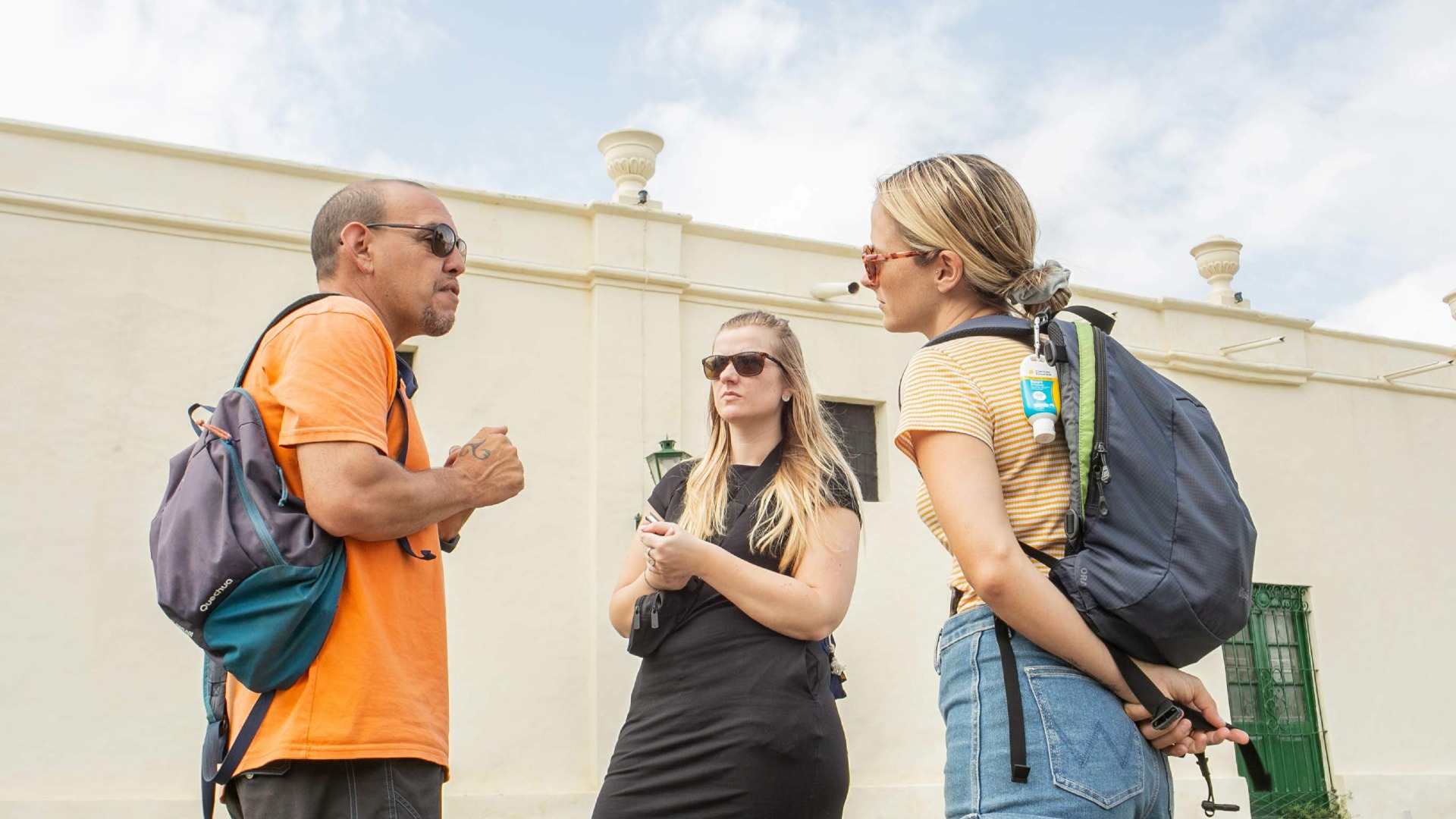
That's what Salta Free Tour is built around. The walk covers Plaza 9 de Julio and the Catedral Basílica, the Cabildo, Iglesia San Francisco, Convento San Bernardo, and Plaza Belgrano in about two hours, led by a local guide who knows which corner of which square actually belongs to the people who live here. It's free to join, no fixed price, and you decide what to leave at the end based on what the walk was worth to you. For a first afternoon in Salta, it's a solid, low-risk way to see the historic center properly instead of guessing your way through it alone.