
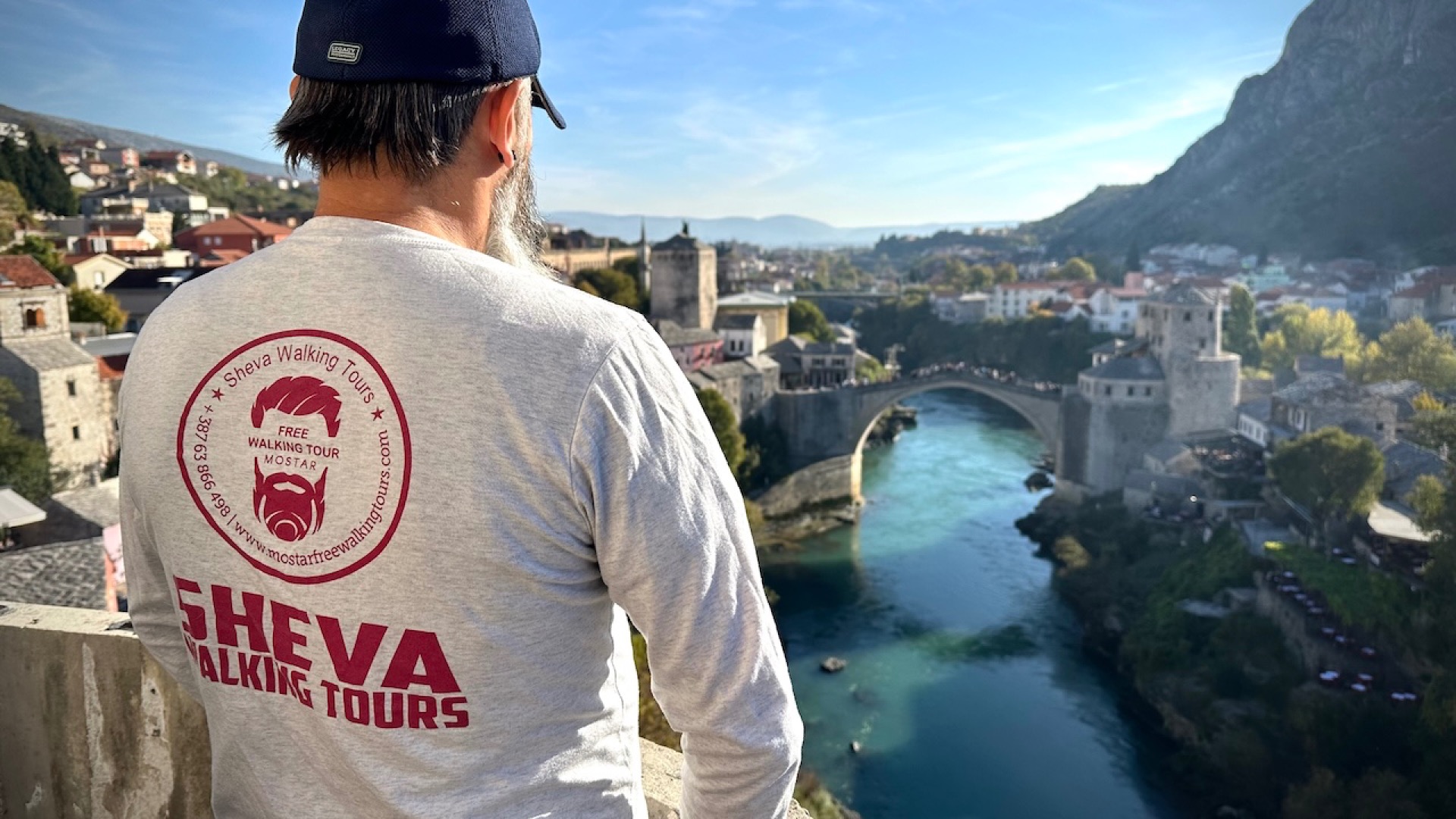
Why Does Mostar Feel Like a City Built Around a Single Bridge?
Stand on Stari Most at midday and you'll understand Mostar in about thirty seconds.
Below you, the Neretva River runs an impossible turquoise. On one bank, minarets. On the other, church bells. Somewhere nearby, a young diver is stretching, working up the nerve to jump twenty meters into water that's colder than it looks. Everyone around you, tourists and locals alike, is watching the same bridge, because in Mostar almost everything eventually comes back to it.
That's not an accident of geography. For centuries this crossing connected people, cultures, religions, and trade across the Neretva, and the city grew up entirely around that function. Walk the Old Town's cobbled streets today and you're walking through a place that has always defined itself by what it connects, not by what it keeps apart.
Why Is the Old Bridge So Central to Mostar's Identity?
The Ottomans built Stari Most in the 16th century, and it stood for over four hundred years as the physical and symbolic link between the two halves of the city. In 1993, during the Bosnian War, it was destroyed. The bridge was rebuilt using traditional techniques and reopened in 2004, and UNESCO recognized the Old Town specifically because of what that rebuilding represented: a deliberate choice to restore a shared symbol after a conflict that had tried to tear the city apart along ethnic and religious lines.
That history is why a walk through Mostar's Old Town isn't just sightseeing. Merchants, artisans, and travelers shaped this place over centuries, and the coexistence between them, along with what it took to rebuild that coexistence after the 1990s, is the real subject of the city.
What Are the Must-See Landmarks in Mostar's Old Town?
Mostar's historic core is small enough to walk in an afternoon, but dense enough that every corner has its own layer of history attached.
Stari Most (the Old Bridge):
The single-arch stone bridge that gives the city its name (Mostar means "bridge keeper"). Local divers still jump from it, a tradition that predates the tourist crowds by generations, and the Mostar Divers Club nearby trains the next generation of jumpers.
Kriva Ćuprija (the Crooked Bridge):
A smaller, older stone bridge tucked away from the main crowds, often overlooked by visitors who only came for the famous one. It's a quieter spot to understand the same Ottoman-era engineering on a smaller scale.
Kujundžiluk:
The old coppersmiths' quarter, where the sound of hammering on metal still drifts through the street. Coppersmithing has been passed down here for generations, and the workshops sell the same kind of engraved trays and pots that merchants have made for centuries.
Koski Mehmed Pasha Mosque:
One of the Old Town's Ottoman-era mosques, worth a stop for its courtyard and minaret view over the river and bridge.
The Old Hamam:
A former Ottoman bathhouse that now operates as a War Photo Exhibition, a deliberate pairing of the city's Ottoman past with its more recent history. It's also the meeting point for both walking tours through the Old Town.
Tabhana and Tabačica Mosque:
Smaller historic sites along the riverbank, part of the dense cluster of Ottoman-era architecture packed into the Old Town's narrow footprint.
Mala Tepe and Mejdan:
Public squares that show a different side of Mostar, less about monuments and more about how the city actually functions day to day, from local coffee culture to the customs still passed down from one generation to the next.
Is Mostar Safe for Tourists?
Mostar is generally safe to walk, but the Old Town's Ottoman-era cobblestones are uneven and not built with accessibility in mind. Anyone with mobility concerns should plan ahead, and families with young children are better off with a baby carrier than a stroller, since strollers struggle badly on these streets.
Beyond the physical layout, the more important thing to understand about Mostar is what's beneath the surface of the postcard views. The bridge, the mosque, and the coppersmith stalls are only part of the story. The rest, the Austro-Hungarian period, socialist Yugoslavia, the 1990s conflict, and what post-war reconstruction actually looked like here, isn't something you'll pick up just by walking past the buildings. It's the kind of context a local guide provides and a guidebook usually skips.
What Should You Wear and Bring in Mostar?
Comfortable walking shoes are non-negotiable given the cobblestones. Bring a refillable water bottle, since fountains are available along most walking routes through the Old Town. Sunscreen and a hat matter in the warmer months, and layers are the better call in winter, when the Neretva valley gets genuinely cold.
How Does Currency and Tipping Work in Mostar?
Bosnia and Herzegovina uses the convertible mark (KM or BAM), and it's the currency you'll want on hand for cafes, small shops, and tipping. On Tripvalory's free tours, there's no upfront cost to book. You join the tour, and at the end you tip your guide based on what the experience was worth to you, with a fair baseline of around €5 per person.
When Is the Best Time to Visit Mostar?
Spring and early autumn bring the most comfortable weather for walking the Old Town for a couple of hours at a stretch, avoiding both the height of summer heat and the damp cold of a Neretva valley winter. Whatever season you visit, the Old Bridge is worth seeing at more than one time of day, since the light off the river changes the whole scene from morning to golden hour.
Ready to Explore Mostar Like a Local?
Mostar isn't a city you understand from photos of one bridge. Its real story sits in the quarters most visitors walk past on their way to take the same picture everyone else takes, the coppersmith stalls, the quieter Crooked Bridge, the squares where the city actually lives its daily life.
Visit Tripvalory.com to book a free walking tour of Mostar's Old Town with a local guide. It costs nothing to reserve, and you pay afterward whatever you think the experience was worth.