
Why Does Bosnia and Herzegovina Feel Like Three Empires Left Their Doors Unlocked?
Walk through Sarajevo's old quarter and you can cross four centuries of history in about two hundred meters.
Ottoman cobblestones give way to Austro-Hungarian pavement at a marker locals call the Meeting of Cultures, and it isn't a metaphor, it's an actual line in the ground where two eras of architecture meet without blending. A muezzin's call overlaps with church bells. A few streets over, a red splash in the pavement, a Sarajevo Rose, marks where a mortar shell hit during the 1990s siege. Nowhere else in the region stacks its history quite this visibly, or quite this close together.
That layering isn't unique to the capital. It's the whole country's personality. Bosnia and Herzegovina sat on the border of empires for centuries, absorbing Ottoman rule, Austro-Hungarian modernization, Yugoslav socialism, and a devastating war in the 1990s, and every one of those periods left something behind that's still standing.
What Defines Bosnia and Herzegovina's Culture and History?
The country's identity was shaped by geography as much as politics. Sitting where the Ottoman Empire met Catholic and Orthodox Europe, Bosnia and Herzegovina became genuinely multi-religious and multi-ethnic, home to Bosniaks (predominantly Muslim), Croats (predominantly Catholic), and Serbs (predominantly Orthodox), living in the same towns for generations.
The Ottomans arrived in the 15th century and stayed for roughly four hundred years, which is why the country's mosques, covered markets, and stone bridges look the way they do. Austro-Hungarian rule followed in the late 19th century, bringing a different architectural language, wider boulevards, grand civic buildings, industrial infrastructure, and it's still visible standing right next to the older Ottoman quarters. Then came socialist Yugoslavia, and then the 1992 to 1995 war, which hit Bosnia and Herzegovina harder than almost anywhere else in the former Yugoslavia and left physical scars that are still part of the everyday landscape.
None of this makes the country feel heavy in a way that keeps visitors away. It makes it feel honest. Nothing here pretends the history didn't happen, and that's part of what makes walking through it with someone who actually lived through or grew up around that history so different from reading about it beforehand.
Which City Should You Visit First?
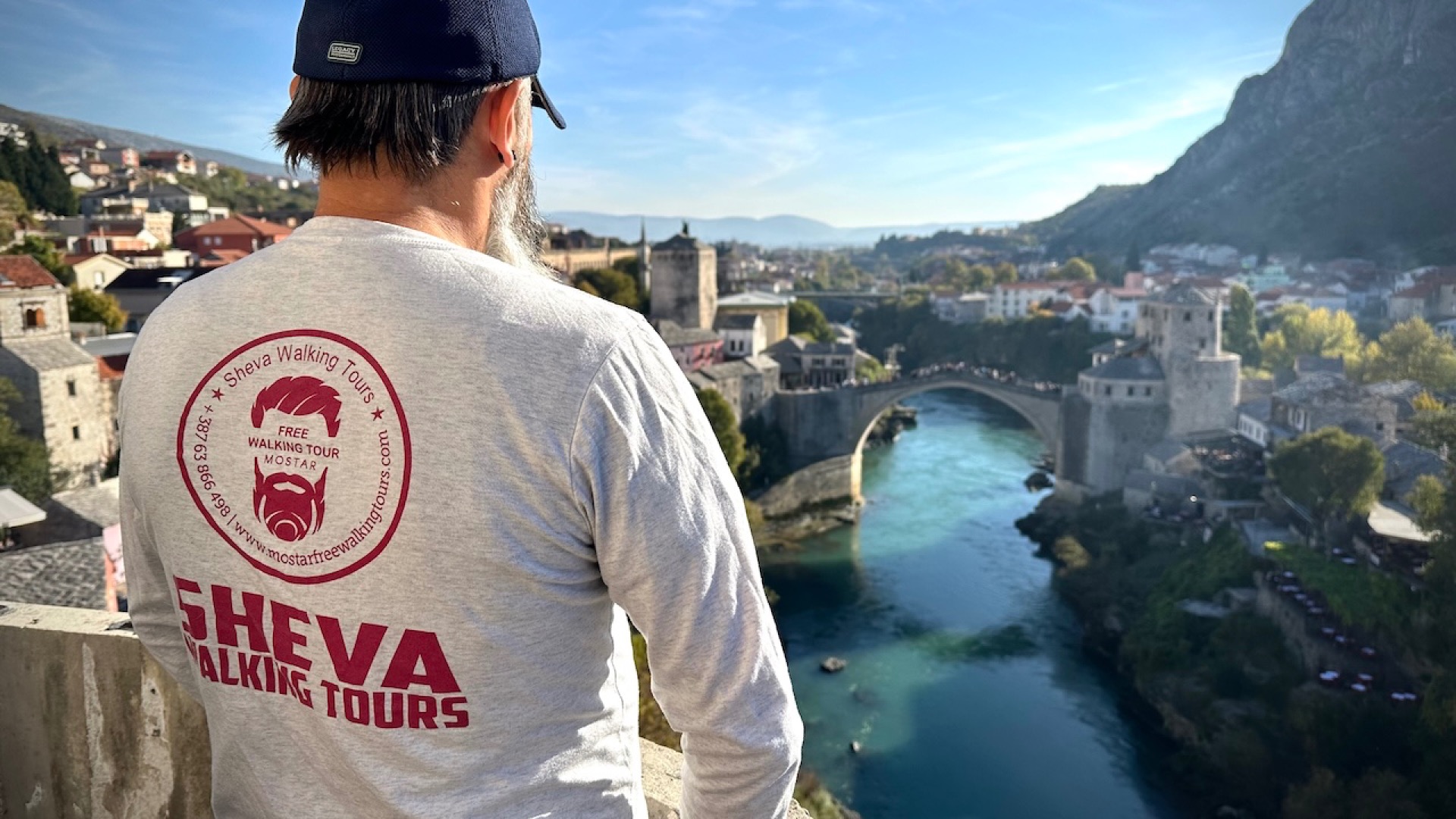
Most people build a Bosnia and Herzegovina trip around Sarajevo, the capital, and Mostar, a smaller city about two hours south. Of the two, Mostar is where Tripvalory's local guides currently operate, and it's also the place where the country's entire layered history gets compressed into a single, walkable Old Town built around one famous bridge.
What Makes Mostar's Old Bridge and Old Town Worth a Full Afternoon?
Mostar takes its name from the bridge that defines it: Stari Most, an Ottoman single-arch stone bridge built in the 16th century, destroyed during the 1993 conflict, and rebuilt with traditional techniques before reopening in 2004. UNESCO recognized the Old Town specifically because of that rebuilding, a deliberate choice to restore a shared symbol after a war that tried to split the city along ethnic lines.
Local divers still jump from the bridge into the Neretva River below, a tradition that predates the tourist crowds by generations. Around it, the Old Town is dense with smaller sites worth slowing down for: Kriva Ćuprija, the quieter Crooked Bridge tucked away from the main crowds, Kujundžiluk, the old coppersmiths' quarter where the sound of hammering on metal still carries through the street, and Koski Mehmed Pasha Mosque, whose courtyard looks straight out over the river.
The Old Hamam, a former Ottoman bathhouse now doubling as a War Photo Exhibition, sits at the center of it all, a deliberate pairing of the city's Ottoman past with its more recent history. Walking this route with a guide who traces the story from medieval trade routes through the Ottoman and Austro-Hungarian periods, into socialist Yugoslavia, and through the 1990s conflict to today, turns a pretty bridge photo into an actual understanding of how the city survived and rebuilt itself.
What Should Travelers Know Before Visiting Bosnia and Herzegovina?
Bosnia and Herzegovina is a Muslim-majority country in terms of the Bosniak population, but it's genuinely multi-religious, and visitors of any background are welcomed without friction. Dress modestly when entering mosques, but everyday dress around the country is casual and Western.
The currency is the convertible mark (KM or BAM), and cash is the more reliable option for cafes, small shops, and tipping, even though cards are increasingly accepted in cities. The country is broadly safe for tourists; the more practical concern is the terrain rather than crime, since Old Town areas like Mostar's are paved with centuries-old, uneven cobblestones that aren't built for strollers or limited mobility. Anyone with accessibility needs is better off contacting a guide in advance.
Tipping culture runs on genuine appreciation, and Tripvalory's model reflects that directly. Tours are free to book, and at the end you tip your guide in local currency based on what the experience was worth to you, with around €5 per person as a fair baseline.
Ready to Explore Bosnia and Herzegovina Like a Local?
Bosnia and Herzegovina isn't a country you can fully take in through a car window on the way to somewhere else. Its most important details, the line where two architectural eras meet, the bridge rebuilt stone by stone, the coppersmith quarter still working the same trade it always has, only make sense with someone who can explain what actually happened here.
Visit Tripvalory.com to book a free walking tour of Mostar's Old Town with a local guide. It costs nothing to reserve, and you pay afterward whatever you think the experience was worth.