
The Inward City: Decoding the True Soul of Marrakech on Foot
The internet is crowded with identical descriptions of Marrakech. If you spend a few minutes searching, you will encounter the same recycled phrases about vibrant colors and bustling souks. But anyone who has actually lived within the ancient clay ramparts knows a fundamental truth. Marrakech cannot be indexed by a search engine, and its true essence completely resists digital navigation.
GPS frequently falters in the five hundred mile labyrinth of the Medina. Street signs are secondary to local landmarks. This is not a structural flaw. It was engineered for the human scale, built for a time when the only way to know a city was to walk its paths and speak to the people who held its memory.
As we introduce Tripvalory.com, we chose Marrakech as our very first official destination for this exact reason. Marrakech is not a city you merely look at from a bus window. It is an intricate environment you must interface with directly. The only true way to experience it is on foot, guided by someone who understands its unspoken codes.
The Geometry of Privacy: An Inward-Facing History
To truly understand Marrakech, you must look at the soil beneath your feet and the mindset of its founders. Established in 1070 by Abu Bakr ibn Umar of the Almoravid dynasty, the city began as a strategic trading hub wrapped in miles of rammed-earth walls. It was this local clay that gave Marrakech its famous moniker, Al-Hamra, which translates to The Red City.
For centuries, Marrakech served as an imperial capital, rising and transforming under successive dynasties. It evolved into a grand crossroads where Sub-Saharan trade routes met Andalusian artistry and Amazigh heritage. Yet, unlike historical Western cities where wealth and prestige are displayed outwardly on grand facades facing the street, Marrakech is entirely inward-facing.
The alleyways of the Medina are intentionally austere, featuring monochromatic, high clay walls with plain, heavy wooden doors. This architecture serves a dual purpose. It repels the intense Saharan heat, and it fiercely guards the privacy of domestic life. You can walk past a plain, windowless wall for twenty minutes, completely unaware that just a few feet away sits a magnificent, multi-tiered courtyard garden filled with ancient olive trees, running water, and brilliant tilework. Marrakech hides its greatest beauty behind a veil of anonymity. Its history is buried deep within the interior centers of its blocks.
The Friction of Engagement: A Global Phenomenon
Today, Marrakech consistently ranks among the top travel destinations in the world, regularly capturing the imagination of global travelers. The secret to this magnetic appeal lies in its balance of ancestral heritage and creative modernity. Marrakech does not exist as a static museum piece. It is a living, breathing ecosystem where twelfth-century ramparts sit gracefully alongside contemporary art galleries and world-class design houses.
More importantly, Marrakech captivates people because it introduces a necessary, brilliant friction to travel. In a modern world designed for passive consumption, where you can cross a city in an insulated rideshare vehicle without looking a single local in the eye, Marrakech demands active participation.
You cannot navigate the Medina passively. You must learn the physical etiquette of sharing narrow alleys with artisan carts and motorbikes. You must ask for directions, negotiate spaces, and engage in the slow, conversational choreography of the markets. The city forces human-to-human contact, effectively curing the loneliness of modern travel by turning a simple walk into a series of genuine social transactions.
Deconstructing the Monuments: A Study in Spatial Transitions
When visiting the major historical landmarks of Marrakech, standard guidebooks focus strictly on dates and dynasties. A localized, pedestrian perspective looks instead at how these historic spaces manipulate human perception.
- The Koutoubia Mosque
Standing at 77 meters tall, the minaret of the Koutoubia Mosque is the spiritual North Star of Marrakech. Completed in the twelfth century under the Almohads, its majestic proportions served as the architectural blueprint for structures across the region, including the Giralda in Seville. Because the surrounding alleys are tight and disorienting, the Koutoubia serves as a constant celestial compass. No matter how deep you wander into the maze, catching a glimpse of its sandstone silhouette above the rooftops instantly grounds your position.
- The Bahia Palace
Built in the late nineteenth century, the Bahia Palace, meaning The Palace of Brilliance, is a masterclass in spatial design and acoustic transition. As you move from the intense energy of the street through a sequence of increasingly private courtyards, the city’s noise drops away in distinct stages. By the time you reach the grand reception halls adorned with intricate zellij tilework, carved stucco, and painted cedarwood ceilings, the only sounds left are the wind through the orange leaves and the gentle trickle of central fountains.
- The Saadian Tombs
Sealed away for centuries and rediscovered only in 1917, this royal burial ground is a breathtaking testament to Morocco’s Golden Age. The monument uses physical compression to create a sense of awe. You enter through a tight, low-lit corridor, only to have the space suddenly fracture upward into the breathtaking heights of the Chamber of the Twelve Pillars. The contrast between the narrow approach and the soaring Italian Carrara marble creates an immediate, visceral impact.
Living Traditions and the Rhythms of Daily Life
Beyond the grand architecture, the true magic of Marrakech is woven into its intangible traditions, which are the daily rituals passed down through generations.
- The Art of Hospitality
Known locally as Diafa, hospitality is a cornerstone of culture. To be a visitor in Marrakech is to be treated with profound respect and generosity.
- The Tea Ritual
No interaction, business transaction, or casual greeting is complete without Atay, the signature Moroccan mint tea. Brewed with green tea leaves, fresh mint, and sugar, it is poured elegantly from high above to create a delicate foam layer, symbolizing the warmth of the welcome.
- The Heritage of Craft
In the depths of the souks, the traditions of the medieval guilds remain entirely alive. You will hear the rhythmic striking of hammers in the blacksmith quarters, see master dyers hanging vivid skeins of wool to dry, and witness woodworkers carving aromatic thuya wood using traditional methods.
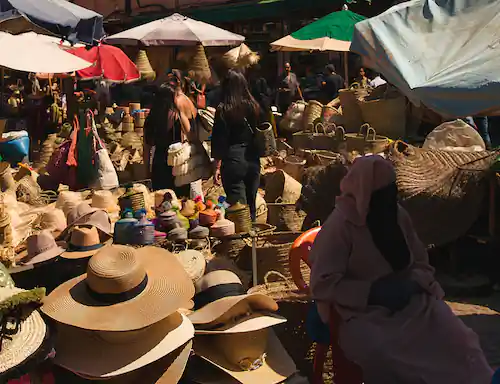
- Jemaa el-Fnaa, The Daily Resettable Theater
Every road in the Medina eventually spills out into Jemaa el-Fnaa, the vast public square that serves as the beating heart of Marrakech. It is an ancient, ephemeral amphitheater that completely erases and rebuilds itself every twenty-four hours.
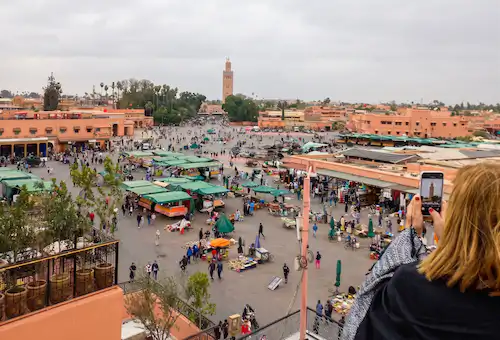
By day, the square is vast, empty, and utilitarian, acting as a wide open space for the dense Medina. But as the sun dips below the horizon and the sky turns a deep indigo, Jemaa el-Fnaa undergoes an extraordinary transformation. Dozens of food stalls open up, sending plumes of aromatic smoke rising into the air, carrying the scents of spiced stews, grilled meats, and freshly squeezed orange juice.
Around these stalls, the Halqa begins. These are the circular gatherings that represent one of the last active oral archives on earth. Long before printing presses or digital servers, North African history, poetry, and satire were preserved through memory and performance. The storytellers, musicians, and poets who occupy the square every single night are not performing a tourist gimmick. They are maintaining an unbroken, centuries-old lineage of intangible human history, earning the square its designation as a UNESCO Masterpiece of the Oral and Intangible Heritage of Humanity.
The Tripvalory Philosophy
If you visit Marrakech with a standard itinerary downloaded from a generic website, you will only see the outer walls. You will miss the inner logic of the alleys, the rhythm of the daily rituals, and the subtle cues that signal where the ancient city ends and modern life begins.
We built Tripvalory because spaces this complex require human translation. The true value of a tour is not just getting from one point to another, it is understanding the invisible world that exists between them. Step onto the pavement, leave the algorithms behind, and let a local guide show you how to truly read the Red City.